

Auctions
Please be aware: Upon placing a bid, your name will be public on the auction page. If you wish to remain anonymous within the public sphere, please name yourself “anonymous”.
Your bid will appear in the ‘bids placed’ section after a few minutes. Check your email (and spam folder) to confirm your bid has been placed, to monitor if you have been outbid, or for an auction winner notification.
Proceeds from auctions support n-Lorem and nano-rare patients.
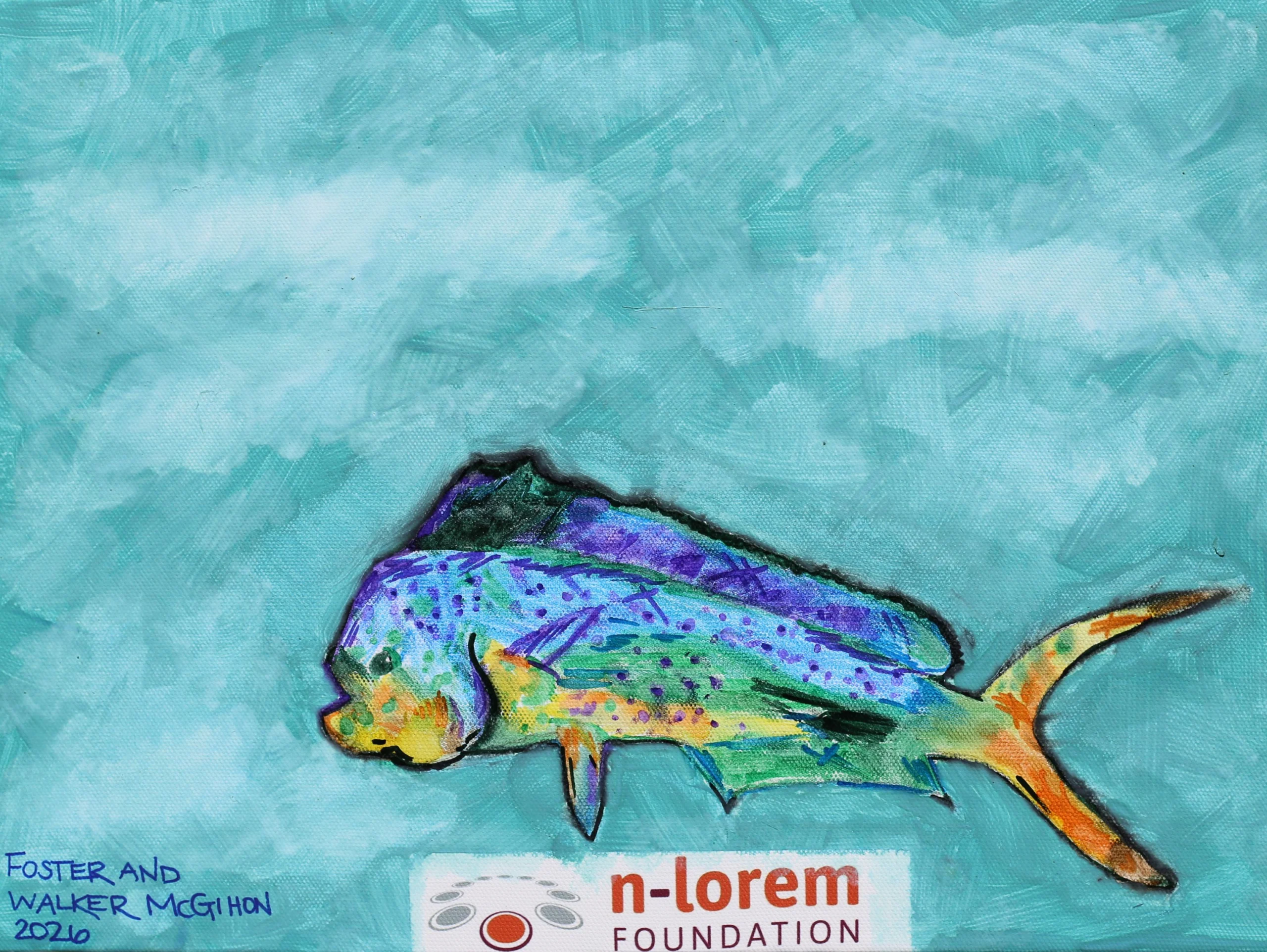

Foster - A Brighter Tide
A Brighter Tide
Program: H3F3A
Foster’s Story:
Foster entered the world in February of 2014 after a perfectly healthy pregnancy. He was our firstborn, much anticipated and much loved long before his arrival. I had a long, difficult labor that ended in a C-section, but we left the hospital a few days later with what we believed was a typical, healthy baby boy. We had no idea how profoundly our lives were about to change.
His first few doctor visits were routine, so we had no cause for concern until he was 13 ounces below his birth weight at one month old. He’d been exclusively breastfed up to that point, but he wasn’t sustaining the suck-swallow-breathe pattern necessary to nurse. He seemed content and wasn’t behaving like a starving baby—crying and upset—so we had no idea. Thankfully, a lactation consultant at a breastfeeding class for new moms jumped all over the situation, calling our pediatrician to get us in immediately and bringing down a physical therapist and speech pathologist from the NICU to look at him right then and there. Switching him to breastmilk by bottle and eventually formula quickly reversed the weight problem. A few months later, he was a baby Buddha! We were relieved and thought perhaps that the first scary bump in the road was behind us.
However, each month seemed to reveal new concerns—not making eye contact, not smiling, and a flat spot on his head requiring PT for torticollis. By five months, he was already a few months behind on milestones and started OT as well. By 10 months, he was even more significantly behind and added speech therapy. It was all so overwhelming. Well-meaning friends and family would suggest diagnoses that might fit and send us into an upsetting tailspin. We had no idea what was going on with our precious baby, but with each passing month, we knew it was more serious. We were learning, little by little, that this was not simply a matter of him being “behind.”
To the credit of our wonderful pediatrician, she didn’t sit on any of this in wait-and-see mode. Not only did she refer us to assorted therapists within the first months of his life, but we were referred to various specialists—genetics, neurology, etc.—too. Still, none could give us any answers. One geneticist, while holding the baby boy who was our whole world in his arms, told us he didn’t know what was going on but believed it was genetic. He then asked, “Are you planning to have more of these because two of these isn’t better than one?” I am still stunned when I recall what a heartless way that was to tell us that we should make sure we weren’t carriers of a genetic condition we might pass on to other children.
Foster wore a helmet for about six months to remedy the flat head. Thanks to countless hours of therapy, he eventually sat on his own at 10 months, crawled at 14 months, and walked at 2 years and 2 months. Every one of those milestones was hard-won, and every one felt like a celebration. However, balance, coordination, and stamina remain major challenges even now. Communication and cognition are most profoundly delayed. For all of Foster’s life, he has remained at the level of an infant in these areas, making only the tiniest, painstakingly slow gains despite 20-plus hours of therapy each week and all the special education supports he receives during the school day. Determining what he wants or needs has been the same guessing game you must do when a newborn cries.
Our lives became—and continue to be—a constant cycle of therapies, appointments, evaluations, and trying to figure out how to help him.
One of the hardest parts of watching Foster grow up has been watching other children his age as they seem to effortlessly move from one milestone to the next. There is a quiet grief in watching life unfold for others in all the ways we had once imagined for Foster. That grief doesn’t really go away. It just changes. There is always another birthday, another school year, another milestone, another reminder of how differently Foster’s life is unfolding. We can be incredibly grateful for the child we have and still grieve the things he may never get to experience. Both things can be true at the same time.
Foster’s reality has also been incredibly isolating. We desperately want to be included in the ordinary things families do together, but bringing Foster along can make even simple gatherings, outings, or trips complicated. We want to be part of the world around us, but sometimes participating with Foster feels so difficult that it is easier to stay home. And even when we are surrounded by people we love, there can be a feeling that no one can quite understand what our day-to-day life is like.
He has relatively good mobility, but his profound intellectual and communication disabilities mean that he has very little understanding of safety, consequences, or social expectations. He is big and strong and can get himself almost anywhere, but he doesn’t understand that he could fall down the stairs, that a hot stove can hurt him, that he shouldn’t put objects in his mouth, or that his actions might damage something or bother another person. That combination can make life especially challenging. His body has grown up while his understanding of the world has not. He is a teenager, but he requires the level of constant supervision you would expect from a much younger child. As he has gotten bigger and stronger, some of these challenges have actually become harder rather than easier.
Just before Foster’s third birthday, whole-exome sequencing revealed a single-letter mutation in his H3F3A gene. We were told at that time that he was only the 12th person in the world to be diagnosed with an H3F3A gene-related disorder, which did not even have a name yet. It’s now called Bryant-Li-Bhoj Syndrome. We finally had a diagnosis, but his doctors had more questions than answers. In the same week, he was also diagnosed with profound autism.
I created a Facebook group for his gene mutation shortly after the diagnosis, but it was a long time before anyone else with a child with the same diagnosis found it. It was such an incredible feeling, after being so alone, to connect with just one other family in the U.S. that was dealing with the same condition. Many more from all around the country and the world have found the group since then. What started out of our own loneliness eventually became a community for families who were just as desperate for answers and connection as we had been.
Thanks to local friends whose son has spinal muscular atrophy and was, I believe, among the first to receive the ASO Spinraza, we were made aware of n-Lorem in 2020. I began trying to get every physician on Foster’s team to apply for him, but that proved to be extremely challenging. I was finally able to get an application submitted, and then came the waiting and wondering before acceptance and eventually, a medicine. Waiting was so hard, knowing that every year that passed was another year of wondering what potential we might be losing while we waited.
Foster began treatment in December of 2024. We must travel from our home in Charleston, SC, to Chicago every 90 days to receive treatment. Traveling with Foster is quite difficult—imagine navigating the airport and flying with a one-year-old who is your size and has your strength, and you’ll have some idea of the challenge—but his team in Chicago is amazing and even stores a special needs safety bed for him at the hospital, which they deliver to the neighboring Hyatt for our visits. My brother travels with us, which is vital, as air travel alone with Foster would be nearly impossible for me to manage, and my husband must stay behind to keep life running as usual for Foster’s younger twin brothers. It is exhausting and complicated, but every 90 days we get on that plane because there is nowhere else we’d rather be!
Since beginning treatment, the gains are truly meaningful. He’s clearly so much more aware of what’s going on around him. His receptive and expressive communication have both improved significantly. His motor planning is also meaningfully improved. For example, he is more coordinated climbing stairs and getting in and out of our SUV. He is beginning to use utensils to feed himself for the first time. He is also beginning to potty train and seems to have a bit of awareness of those bodily signals, which has never been the case before. These may sound like very small things to someone else. To us, they are enormous. Little by little, developmental windows that were thought to be closed to him are reopening!
While simplistic, we are able to have conversations with him using his AAC device—an iPad with a speech app called Proloquo2Go—and ask simple questions he can answer by tapping yes/no, more/all done, or touching the picture of the food he wants, for example. Just being able to ask if he likes his new teacher or if he’s still hungry are amazing blessings!
Foster is a happy and lovable kid who is growing like a weed. We are beyond grateful for the opportunity to have him treated by his bespoke ASO. For so many years, we learned to make our hopes smaller. We celebrated every tiny gain because we knew how hard-earned it was while quietly trying to make peace with all the things we weren’t sure Foster would ever be able to do. Now, for the first time, we find ourselves wondering if perhaps we made those hopes too small.
Thanks to n-Lorem, we are “dreaming bigger and hoping for more.” There truly are no words to express our gratitude to Dr. Crooke and everyone who is part of the n-Lorem team or providing support to them in any way.
* In 2024, Foster received his first dose of a personalized experimental ASO medicine discovered and developed by n-Lorem
| Bidder Name | Bid Price | When |
|---|---|---|
| Jessica Sylvester | $160.00 USD | 18 days ago |
| Clara Kearns- “Cure for Clara” | $150.00 USD | 43 days ago |
| Judy Johnson | $125.00 USD | 48 days ago |
| Virginia Sankey | $100.00 USD | 50 days ago |
| Julie Anderson | $75.00 USD | 52 days ago |
| Judy Johnson | $50.00 USD | 53 days ago |


